


10 Reasons Retailers and Boutiques Should Buy Bulk Tote Bags!
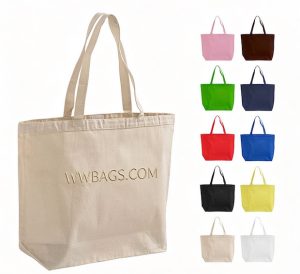
Walk through any successful retail store and you’ll notice the same quiet workhorse: the reusable tote. It carries a customer’s purchase, then travels through the city carrying your logo.
Für Einzelhändler and boutiques, buying tote bags in bulk isn’t a packaging expense — it’s one of the cheapest advertising channels available, with a cost per impression that paid media can’t touch.
This guide covers why bulk tote bags matter, how the main materials compare, ten concrete reasons to order in volume, how to pick the right bag for your store type, and a final B2B buyer’s checklist before you place a purchase order.
Why Bulk Tote Bags Are Essential for Retailers and Boutiques?
Single-unit ordering is a trap. Buying bags one at a time or in small retail packs destroys your margins, because unit price falls sharply as quantity rises — and customization (screen printing, embroidery, DTG) is only economical at volume.
Bulk buying gives you four things: a low cost per bag that you can absorb as marketing spend, consistent colour and sizing across an entire season, a logo on every bag that leaves the store, and a stock buffer so you never run out during a promotion, holiday rush or trade show.
For boutique owners especially, a well-made tote is also merchandise-adjacent — customers photograph it, reuse it and effectively become walking billboards for your brand.
Tote Bag Materials Compared:
The table below compares the six materials most retailers order:
What the data means: fabric weight drives price far more than logo size. Moving a logo from 20 cm to 25 cm wide changes cost by cents; jumping from 6 oz cotton to 12 oz canvas moves you from a sub-$1 bag into the $3–6 band.
Buy weight by use case, not by habit. A 12 oz canvas with single-stitch handles can be weaker than an 8 oz cotton bag with bar-tacked, cross-stitched stress points — always specify handle reinforcement .
Note too that a standard 80 gsm non-woven bag is best understood as semi-reusable, designed for roughly 20–50 trips before seams fail .
10 Reasons Retailers and Boutiques Should Buy Bulk Tote Bags: – 1
1.Lower Unit Cost at Scale
Volume pricing transforms your economics. Ordering 1,000 or 5,000 bags instead of a few dozen cuts the price per bag dramatically, because factories spread fixed setup, screen-making and machine time across far more units. That saving frees budget for better materials or bigger print areas.
2. Cheap, Permanent Brand Exposure
Every bag that leaves your store carries your name through streets, cafés and offices. Unlike a paid ad that stops the moment spending ends, a printed tote keeps working for years at a cost of pennies per impression — one of the lowest-cost branding channels available to any retailer.
3. Customization Becomes Affordable
Screen printing, DTG and embroidery are priced as a setup fee plus a per-unit charge. At low volumes the setup dominates and customization feels expensive; across thousands of bags it shrinks to cents each. Bulk ordering is what makes a genuinely custom, on-brand bag viable.
10 Reasons Retailers and Boutiques Should Buy Bulk Tote Bags: – 2
4. Free Advertising Through Customer Reuse
Customers don’t throw away good bags — they reuse them for groceries, gym kit and travel. Each reuse is an unpaid, third-party endorsement seen by people who trust the carrier. One well-made tote can generate thousands of brand impressions over its lifetime, entirely for free.
5. Zero-Waste Retail Positioning
Plastic bag bans and customer expectations now make reusable packaging a reputational issue, not just an operational one. Offering sturdy reusable totes signals environmental responsibility, reduces single-use plastic consumption, and supports the sustainability commitments retailers increasingly publish in annual reports and ESG disclosures.
6. Instant Packaging Upgrade
A quality tote turns an ordinary purchase into something that feels considered. Instead of flimsy plastic that ends up in a bin, the customer receives packaging they keep and value. This elevates the unboxing moment and perceived product quality without the expense of custom boxes, tissue or rigid gift packaging.
10 Reasons Retailers and Boutiques Should Buy Bulk Tote Bags: – 3
7. Reliable Stock Control
Running out of bags mid-promotion or during holiday peaks is embarrassing and costly. Bulk inventory means you always have enough for daily trading, seasonal surges, pop-up shops and trade shows. Predictable stock also lets you plan print runs around campaigns rather than reacting to shortages.
8. Staff, Event and PR Versatility
One bulk order quietly covers many needs: staff uniforms, conference giveaways, press and influencer kits, loyalty rewards, charity donations and sponsorship activations. Instead of sourcing separately for each purpose, you build a single consistent branded asset that works across every customer touchpoint you operate.
9. Better Negotiation Leverage
Larger orders unlock better terms — sharper unit prices, priority production slots, waived or reduced setup fees, more generous payment terms and greater flexibility on print colours and sizes. Suppliers protect big accounts; walking in with a serious volume commitment puts you in a far stronger bargaining position.
10. A Uniform, Professional Look
Consistent colour, size, handle type and logo placement across every store and channel builds recognition and trust. Customers begin to associate your bag with your brand instantly. Fragmented, mismatched bags look improvised; a single coherent tote programme looks like a retailer that knows exactly what it is.
Bottom line: each reason compounds. Lower unit cost buys better material, better material earns more reuses, and more reuses multiply the advertising value — which is why bulk ordering is a marketing decision as much as a purchasing one.
How to Choose Tote Bags for Different Retail Stores?
Rule of thumb: choose fabric weight by load and reuse, not by looks. If the bag must carry over ~5 kg, specify 12 oz canvas plus a reinforced base and riveted handles — the base seam, not the fabric weight, is usually the failure point .
Final Checklist for B2B Tote Bag Buyers:
- Define the use case and target number of reuses (one-day event vs. multi-year merchandise).
- Specify fabric and weight in both oz and gsm to avoid comparable-looking quotes.
- Confirm exact dimensions, gusset depth and handle length/type.
- Check handle attachment: bar-tacks, cross-stitching, rivets at stress points.
- Confirm print method (screen, DTG, embroidery), number of colours, imprint area and placement.
- Ask for a physical sample or pre-production proof before mass production.
- Verify MOQ and price breaks at 500 / 1,000 / 5,000 pcs.
- Request lead time for production plus shipping, and confirm the shipping terms (FOB, ex-works, DDP).
- Check compliance documentation: REACH, BSCI, SGS, FDA where relevant, plus OEKO-TEX or recycled-content certificates if you’re claiming sustainability.
- Compare landed cost, not unit price — include freight, duties and packaging.
- Confirm quality terms: defect rate, inspection process, replacement policy.
- Ask about retained samples and repeat-order consistency.
Häufig gestellte Fragen: – 1
1. What is the minimum order quantity (MOQ) for custom printed tote bags?
MOQs depend on material and decoration method. Industry-typical starting points are 100–500 pcs for screen-printed non-woven and cotton, 500 pcs and up for jute and laminated bags, and higher thresholds for embroidery or full-colour DTG because setup and machine time dominate. Always ask for MOQ per colour und per size — mixing can bump the effective minimum.
2. How much should I budget per bag?
As a planning rule, blank non-woven sits around $0.05–0.10 at 5,000+ pcs, printed 6–8 oz cotton around $0.40–1.20 at 500 pcs, jute around $0.98–1.85, laminated $1.20–2.00, and 10–12 oz canvas $2.84–6.37. Add print setup, freight and duties to get the true landed cost, which is the only number worth comparing.
3. How long does production and shipping take?
Production typically runs 10–15 days after artwork proof approval for standard materials and print methods. Add sampling time (usually 5–7 days) before that, and transit time after — roughly 20–35 days by sea to Europe or North America, or 5–10 days by air. Order at least 6–8 weeks before a launch or seasonal event.
Häufig gestellte Fragen: – 2
4. Can I mix sizes, colours and materials in one order?
Usually yes, and it’s often smart: one order can cover a cheap in-store carrier plus a premium canvas tier for VIP customers. Confirm how mixing affects price breaks, since volume discounts are often calculated per SKU rather than per total quantity.
5. Which printing method is right for my logo?
Screen printing is cheapest and most durable for 1–4 spot colours on cotton, canvas and non-woven. DTG or digital transfer suits photographic, full-colour or gradient artwork but costs more per unit. Embroidery gives a premium tactile finish for canvas and corporate bags but adds cost and has a minimum stitch/detail limit.
6. Are non-woven bags actually eco-friendly?
Non-woven PP is a plastic-derived material and is not biodegradable, so avoid calling it “eco-friendly” in marketing. Its green claim rests on reuse: one bag replacing dozens of single-use plastic carriers. For a defensible sustainability story, choose jute, uncoated kraft paper or certified organic/recycled cotton — and be ready to show the certificate .
7. Should I order a sample before mass production?
Yes — always. A pre-production sample or proof lets you check fabric weight and hand-feel, stitch density, print colour match, dimensions, gusset depth, handle length and hardware before thousands of bags are made. Treat the approved sample as the contractual quality standard and ask for it to be retained.
Häufig gestellte Fragen: – 3
8. What artwork files do you need?
Vector files are best: AI, EPS or PDF with text converted to outlines, or high-resolution PNG/TIFF at 300 dpi for DTG. Include the Pantone reference for each colour, plus the exact imprint size and placement (e.g. “20 cm wide, centred, 8 cm from top edge”).
9. Do you ship internationally, and who handles duties and customs?
Most wholesale suppliers ship worldwide under FOB, ex-works or DDP terms. Under DDP the supplier handles duties and delivery; under FOB you arrange freight and pay import duties and taxes yourself. Ask for an HS code and confirm whether the supplier provides commercial invoices and compliance documents for customs.
10. What payment terms and quality guarantees are standard?
Typical terms are a 30–50% deposit with the balance before shipment, via T/T, PayPal or trade assurance. Ask specifically about the acceptable defect rate, whether a third-party inspection is allowed before shipping, the replacement or credit policy for faulty goods, and whether repeat orders are guaranteed to match the approved sample.
Bonus: how do I stop handles from breaking?
Specify bar-tacked or cross-stitched handle attachment, rivets at stress points, and a reinforced or boxed base for loads above roughly 5 kg. The handle seam and base seam fail long before the fabric does, so reinforcement there buys far more lifespan than simply upgrading to a heavier fabric