


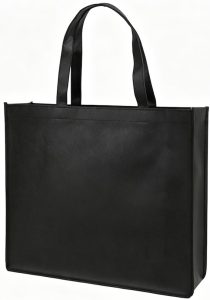


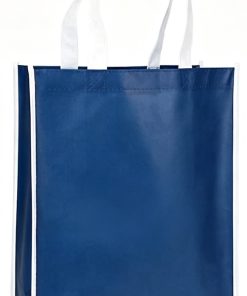
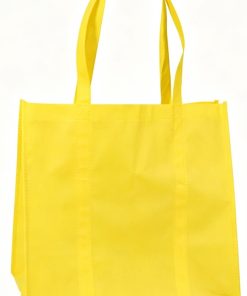
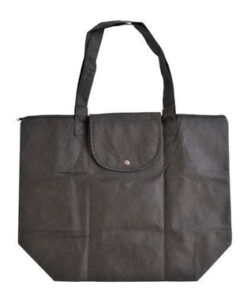
Strike a golden winner with Heavy Duty PP Lamination Custom Logo Full Printing Shopping Eco-Friendly Black Non Woven Tote Bag!
- Made of recycled 80 gsm non-woven polypropylene
- Features 48″ long handle and plastic bottom board inside to add support.
- Huge print area for your logo and details ensures your message won’t get missed.
Non-woven bags make from a type of plastic called polypropylene, nowadays used for carpets, textiles, and packaging materials. Polypropylene is water-resistant and durable, making it a perfect material for a reusable bag.
Product Specification about Heavy Duty PP Lamination Custom Logo Full Printing Shopping Eco-Friendly Black Non Woven Tote Bag:
| Item | Full Printing Shopping Eco-Friendly Black Non Woven Tote Bag |
|---|---|
| Material | 80g Non-Woven Polypropylene |
| Size | 16″*4“*15” |
| Handle | Non-Woven Polypropylene (X Stitching) |
| Printing | Silk screen / Heat transfer / Digital |
| MOQ | 500-1000 pcs |
| Packaging | Carton or customized packaging |
| Usage |
What is a Packaging Inspection: – 1
Packaging inspection is the process of examining, measuring, or testing packaging to confirm that it meets approved quality requirements. For custom packaging, inspectors compare the actual product with agreed specifications, artwork, samples, tolerances, and functional requirements. This means inspection does not rely only on visible appearance.
It also checks whether the packaging matches the material, dimensions, structure, printing, finishing, and performance standards defined for the order. The exact scope varies by packaging type because a reusable fabric bag, paper box, flexible pouch, or retail paper bag has different quality risks and acceptance criteria.
1.Quality Assurance vs Quality Control vs Packaging Inspection:
Quality assurance focuses on preventing problems, while quality control identifies and controls deviations during production. Packaging inspection supports both by providing the measurements, observations, and test results needed to confirm whether the packaging meets the approved requirements.
For a bulk custom packaging order, these activities work together. A clear specification gives the factory a production target. An approved sample establishes a physical reference where appropriate. Production controls help maintain that target, while inspections confirm whether the actual packaging continues to meet it.
| Term | Primary Purpose | Custom Packaging Example |
| Quality assurance (QA) | Establish processes that prevent quality problems | Define specifications, approval procedures, production requirements, and inspection criteria before production |
| Quality control (QC) | Control and verify quality throughout production | Check materials, first pieces, production consistency, finished packaging, and packing |
| Packaging inspection | Examine or test packaging against defined requirements | Measure dimensions, compare print colors, inspect seams, test closures, or verify carton quantities |
What is a Packaging Inspection: – 2
2.Common Packaging Inspection Methods
Packaging inspection combines several methods because one check cannot confirm every quality requirement. Visual and dimensional inspections identify appearance and size issues, while material, mechanical, and print checks verify properties that need measurement or testing. The methods you use should match the packaging material, structure, printing process, and intended function.
a.Visual Inspection:
Visual inspection is the most direct way to identify visible defects in finished packaging. Inspectors look for stains, scratches, deformation, uneven seams, poor gluing, damaged surfaces, wrinkles, loose threads, and other workmanship issues. They also compare the overall appearance with the approved sample, artwork, or defect criteria when available. The process can rely on manual checks or machine-vision systems with cameras and image-processing software to detect repeatable defects in high-volume production.
b.Dimensional Inspection:
Inspectors use rulers, measuring tapes, calipers, thickness gauges, or other suitable measuring tools to verify dimensions against the approved specification and tolerance. Measurements can include length, width, height, gusset depth, opening size, material thickness, handle position, or print position. The relevant measurements depend on the packaging structure.
c.Material Testing:
Material testing evaluates the physical properties and, when required, chemical characteristics of packaging materials. Typical checks may include fabric GSM, paper or board thickness, film thickness, tensile strength, tear resistance, and moisture resistance. ASTM International publishes paper and packaging standards for evaluating physical, mechanical, and chemical properties such as tensile breaking strength, peel adhesion, and water, oil, and tear resistance. Chemical or composition testing may also apply when the packaging has specific food-contact, restricted-substance, or material compliance requirements.
d.Mechanical and Functional Testing
These tests confirm whether the packaging performs as intended. For example, a reusable shopping bag may need handle-load, seam-strength, zipper, or drawstring checks, while flexible packaging may require seal-strength or leak testing. Boxes and shipping packaging may require compression or drop testing when transport performance is part of the specification.
e.Print and Color Verification:
Inspectors compare printing with the approved artwork, color reference, or sample. They check registration, logo position, print clarity, text, orientation, and visible color variation. For tighter color requirements, a spectrophotometer or colorimeter can provide numerical color measurements instead of relying only on visual judgment. Rub or adhesion tests can also help evaluate whether ink, coatings, or printed surfaces remain intact during normal handling.

Reviews
There are no reviews yet.